
Blog
What Is Testosterone Enanthate Used For?
May
Testosterone Enanthate
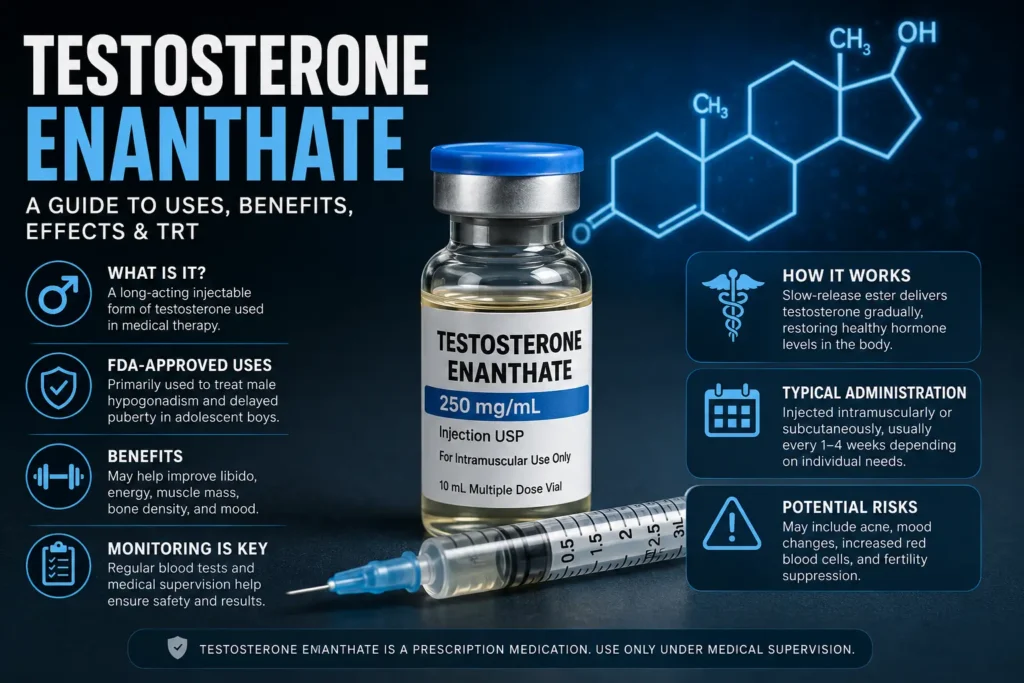
Testosterone enanthate is one of the most commonly prescribed forms of injectable testosterone in the world. If you’ve searched “what is testosterone enanthate used for,” you’re probably trying to understand why a doctor prescribed it, whether it’s the same as anabolic steroids you’ve heard about, or how it fits into testosterone replacement therapy (TRT). This guide breaks down exactly what testosterone enanthate is approved to treat, how it works in the body, what a typical treatment course looks like, and the risks every patient should understand before starting therapy.
What Is Testosterone Enanthate?
Testosterone enanthate is a synthetic, injectable form of testosterone, the primary male sex hormone. Chemically, it’s testosterone attached to an enanthate ester, a fatty acid side chain that slows the hormone’s release into the bloodstream after an intramuscular or subcutaneous injection. Without the ester, plain testosterone would be absorbed and cleared within hours. With it, a single injection maintains elevated testosterone levels for one to several weeks.
Because of this slow release property, testosterone enanthate belongs to a category of drugs called long-acting testosterone esters, alongside testosterone cypionate and testosterone undecanoate. It’s classified in the United States as a Schedule III controlled substance under the Anabolic Steroids Control Act, meaning it is legal only with a valid prescription from a licensed healthcare provider and is dispensed exclusively through a pharmacy.
How Testosterone Enanthate Works in the Body
Once injected, testosterone enanthate is gradually cleaved by enzymes in the bloodstream, releasing free testosterone that binds to androgen receptors throughout the body. This receptor activity drives the functions naturally regulated by testosterone: development of male secondary sexual characteristics, maintenance of muscle mass and bone density, red blood cell production, libido, mood regulation, and sperm production.
Pharmacokinetic studies show that testosterone levels typically peak within 24 to 48 hours of an injection and then decline gradually over the following one to three weeks, depending on the dose and injection frequency a clinician prescribes. This is why testosterone enanthate is given as a scheduled injection, usually every one to four weeks, rather than daily, unlike topical gels or short-acting formulations.
FDA-Approved Medical Uses of Testosterone Enanthate
Testosterone enanthate has a narrow, well-defined set of FDA-approved indications. Understanding these helps separate legitimate medical use from misuse.
1. Male Hypogonadism
The primary and most common approved use of testosterone enanthate is testosterone replacement therapy for men whose bodies do not produce enough testosterone on their own, a condition called hypogonadism. Doctors generally divide this into two categories:
• Primary hypogonadism: The testicles themselves fail to produce adequate testosterone, due to causes such as cryptorchidism, undescended testicles, testicular injury, orchitis, chemotherapy, Klinefelter syndrome, or surgical removal of the testicles.
• Secondary hypogonadism: The pituitary gland or hypothalamus fails to send the hormonal signals that trigger testosterone production, often due to pituitary tumors, trauma, or other structural conditions.
Men with either form of hypogonadism may experience low libido, erectile dysfunction, persistent fatigue, loss of muscle mass, mood changes, and reduced bone density. Testosterone enanthate is prescribed to restore testosterone to a healthy physiological range and relieve these symptoms, but only after hypogonadism has been confirmed with blood testing, not based on symptoms alone.
2. Delayed Puberty in Adolescent Boys
Testosterone enanthate is also FDA-approved for select adolescent males with confirmed constitutional delay of growth and puberty. In these cases, a pediatric endocrinologist may prescribe a short, carefully monitored course of low-dose testosterone enanthate to help initiate the physical changes of puberty, always allowing the body’s own hormonal system to take over.
3. Historical Use in Metastatic Breast Cancer
Older FDA labeling included testosterone enanthate as a palliative option for certain postmenopausal women with inoperable, metastatic breast cancer. This use has largely been replaced by more modern oncology treatments and is now rare in clinical practice, though it remains part of the drug’s regulatory history.
Off-Label and Non-Medical Use: What to Know
Because testosterone enanthate increases muscle protein synthesis and red blood cell production, it is sometimes used outside these approved indications, most notably by athletes and bodybuilders seeking to enhance performance or physique. This use is not FDA-approved, is not supported by a legitimate medical diagnosis, and carries meaningfully higher health risks because doses used for performance purposes are typically far above what the body needs or what a physician would prescribe for hypogonadism.
Non-prescribed use is also illegal in the United States without a valid prescription, and in most countries testosterone enanthate is similarly restricted. Anyone considering testosterone therapy for reasons outside of a diagnosed medical condition should speak with a licensed physician, since unsupervised use removes the safety monitoring, bloodwork, blood pressure checks, and dose titration that makes prescribed TRT comparatively safe.
How Doctors Diagnose the Need for Testosterone Therapy
Testosterone enanthate is never prescribed on symptoms alone. Current clinical guidelines, including those from the Endocrine Society, call for confirming low testosterone with at least two separate morning blood tests, since testosterone naturally peaks earlier in the day and fluctuates from one day to the next. A single low reading isn’t considered diagnostic.
A thorough workup typically also includes assessing symptoms, such as fatigue, low libido, erectile dysfunction, and mood changes, ruling out other causes such as thyroid disorders, checking related hormones like LH and FSH to distinguish primary from secondary hypogonadism, and reviewing overall cardiovascular and prostate health before treatment begins.
How Testosterone Enanthate Is Typically Administered
When prescribed for adult male hypogonadism, testosterone enanthate is given as an intramuscular or subcutaneous injection, most often in the gluteal muscle, thigh, or abdomen. Dosing and frequency vary significantly based on lab results, symptoms, and individual response, and are determined entirely by the prescribing physician. There is no universal “correct” dose.
After starting therapy, clinicians recheck testosterone levels, typically drawn as a trough level shortly before the next scheduled injection, around six weeks in, then periodically thereafter, adjusting the dose to keep levels within a normal physiological range rather than pushing them artificially high.
Potential Side Effects and Risks
Like any hormone therapy, testosterone enanthate carries real risks, which is why it requires medical supervision rather than self-administration.
• Cardiovascular effects: Testosterone therapy can raise blood pressure and, in some men, has been associated with an increased risk of heart attack, stroke, and blood clots, including deep vein thrombosis and pulmonary embolism.
• Polycythemia: An increase in red blood cell count that thickens the blood and raises clotting risk, requiring routine bloodwork to monitor.
• Reproductive effects: Exogenous testosterone can suppress the body’s natural testosterone and sperm production, sometimes leading to testicular shrinkage and reduced fertility.
• Skin and injection site reactions: Acne, oily skin, and pain, swelling, or bruising at the injection site are common.
• Mood and behavioral changes: Some men report irritability, mood swings, or aggression, particularly at higher doses.
• Prostate effects: Testosterone therapy requires baseline and ongoing prostate monitoring, especially in older men.
• Sleep apnea: Testosterone therapy can worsen or unmask obstructive sleep apnea in susceptible individuals.
These risks are one reason testosterone enanthate carries a boxed warning on its FDA label regarding cardiovascular events, and why treatment always involves regular follow-up labs rather than a one-time prescription.
Who Should Not Use Testosterone Enanthate
Testosterone enanthate is contraindicated or requires extra caution in several groups, including men with known or suspected prostate or breast cancer, men with severely elevated red blood cell counts, polycythemia, those with untreated severe sleep apnea, men trying to conceive in the near term due to fertility suppression, and anyone with a history of hypersensitivity to the medication or its components. A physician evaluates each patient’s full medical history before prescribing.
Testosterone Enanthate vs. Other Testosterone Esters
Testosterone enanthate is often compared with testosterone cypionate, its closest clinical equivalent. Both are long-acting esters with very similar half-lives, dosing schedules, and side effect profiles, and studies generally show no clinically meaningful difference between them for treating hypogonadism. The choice often comes down to physician preference, insurance coverage, or availability.
Testosterone undecanoate, in contrast, is longer acting still, allowing injections as infrequently as every 10 to 12 weeks, while short-acting options like testosterone propionate require injections every one to two days and are less commonly used for standard TRT.
Monitoring During Treatment
Ongoing testosterone therapy isn’t “set and forget.” Patients on testosterone enanthate typically have periodic follow-up that includes total and sometimes free testosterone levels, hematocrit and hemoglobin to screen for polycythemia, lipid panels, prostate-specific antigen (PSA) in appropriate age groups, and blood pressure checks.
This monitoring is what allows a physician to catch and manage side effects early, rather than after they become serious.
Legal Status in the United States
Testosterone enanthate is classified as a Schedule III controlled substance under U.S. federal law. That means possessing it without a valid prescription, or distributing it outside of licensed medical and pharmacy channels, is a federal offense. Legitimate treatment always starts with an in-person or telehealth evaluation, a lab-confirmed diagnosis, and a prescription filled at a licensed pharmacy.
Frequently Asked Questions
Is testosterone enanthate the same as anabolic steroids?
Testosterone enanthate is technically classified as an anabolic androgenic steroid because it’s a synthetic version of testosterone. In a medical context, though, it’s used as a replacement hormone to restore normal levels, not to push levels above what the body would naturally produce, which is what distinguishes therapeutic use from performance-enhancing misuse.
How long does it take to feel effects after starting testosterone enanthate?
Some men notice improvements in mood, energy, and libido within a few weeks, while changes in muscle mass, body composition, and bone density typically take three to six months of consistent therapy to become measurable.
Can women be prescribed testosterone enanthate?
It has historical FDA approval for a narrow use in certain metastatic breast cancer cases, but this is now uncommon. Testosterone enanthate is not approved or typically used for general low testosterone symptoms in women.
Does insurance cover testosterone enanthate?
In the U.S., testosterone enanthate is generally covered by insurance when prescribed for a documented medical diagnosis such as hypogonadism, though prior authorization is sometimes required. Coverage varies by plan.
Is testosterone enanthate safe long term?
For men with confirmed hypogonadism who are properly monitored, long-term therapy is generally considered safe and beneficial, though it does carry the cardiovascular, blood, and prostate-related risks outlined above, which is exactly why ongoing monitoring matters.
When to Talk to a Doctor
If you’re experiencing symptoms like persistent fatigue, low libido, erectile dysfunction, or unexplained loss of muscle mass, the right first step is a conversation with a physician and a morning blood test, not starting testosterone on your own. A proper diagnosis ensures that testosterone enanthate, if appropriate, is dosed safely and monitored correctly, and that any underlying condition causing your symptoms isn’t missed.
Medical Disclaimer
This article is for educational and informational purposes only and is not a substitute for professional medical advice, diagnosis, or treatment. Testosterone enanthate is a prescription-only, federally controlled medication. Always seek the guidance of a licensed physician before starting, stopping, or changing any hormone therapy.
